
5 Essential Books About Paris in the 1920s

There’s a certain kind of magic that happens when literature meets a specific place and time. As these books about Paris in the 1920s show, few places have better captured the imagination of writers and readers. It was a moment suspended between wars, when the city pulsed with jazz, art, alcohol, and ideas. A haven for misfits and modernists, Paris became the epicenter of a cultural shift that rippled through generations. Not content to just pass through, many writers lived there, fought there, drank there, broke down and reinvented themselves there. The result is a body of literature that doesn’t just depict a place, but embodies a mood, a state of mind, a restless kind of searching.
The appeal of 1920s Paris wasn’t just the city itself, but what it represented: freedom, reinvention, escape. For American expats, especially, Paris offered a kind of creative asylum. They could write without the constraints of their homeland, and more importantly, live without them. For European surrealists and modernists, it was a place to destroy old forms and build something stranger and truer in their place. For women, queers, and people on the margins, it was often the only place where they could exist as themselves, or at least try to.
This post isn’t about nostalgia. It’s about trying to understand what made that moment so electric, and why the literature from it still resonates nearly a century later. The five books below don’t cover the whole story, but they offer five distinct lenses into that chaotic, luminous, haunted time. Some are raw and confessional, some are mythologized, while some feel like lucid dreams. Together, they offer a kind of emotional history of 1920s Paris, as well as a reminder that literature often gets closest to the truth when it doesn’t try to explain too much.
The Sun Also Rises & A Moveable Feast – Ernest Hemingway’s Paris in the 1920s
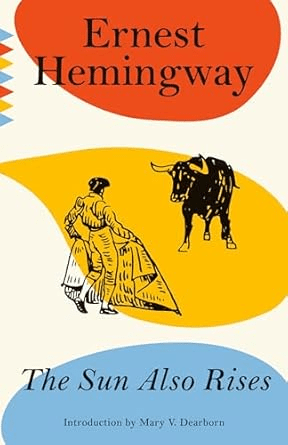

You can’t talk books about Paris in the 1920s without talking about Hemingway. He was one of the loudest voices of the so-called Lost Generation, and Paris is where he found it. If you want to understand what that phrase meant—the sense of postwar aimlessness, emotional dislocation, and creative hunger—you don’t need a textbook. You just need these two books (I cheated and put both here, so we really have six!).
The Sun Also Rises is a novel, but it reads more like a confession wrapped in fiction. Jake Barnes is our narrator, wounded both literally and emotionally from the war. He drifts through Paris and Spain with a group of equally adrift friends, drinking too much, feeling too much, saying too little. On the surface, it’s about a love triangle. Underneath, it’s about the trauma no one can talk about and the longing that never quite gets resolved. Hemingway’s signature spare and direct style lets the emotion seep through the cracks. Paris in this book is a city of cafes, conversations, and absinthe-soaked evenings where everyone is pretending they’re fine. As you read the book you find that they’re definitely not.
Decades later, Hemingway returned to those same years in A Moveable Feast, his memoir of life as a struggling young writer in Paris. It’s softer, more nostalgic, but still clear-eyed. He writes about writing in cafes on cold mornings, about his first wife Hadley, about Gertrude Stein, Ezra Pound, and F. Scott Fitzgerald. He captures what it felt like to be broke and in love and hungry. There’s a warmth here that doesn’t show up in his early fiction. A kind of rueful tenderness, which is what stuck with me the most when I read it.
Together, these books show both sides of the expat experience: the rawness of living it, and the melancholy of remembering it. Hemingway wasn’t always kind, but he was honest. And his Paris, whether seen in real-time or in hindsight, still feels painfully alive.
Buy The Sun Also Rises: Amazon | Bookshop
Buy A Movable Feast: Amazon | Bookshop
Tender Is the Night – F. Scott Fitzgerald’s Jazz Age Paris

Fitzgerald arrived in Paris with Zelda and a suitcase full of dreams. But by the time Tender Is the Night came out in 1934, the dream had soured.
While much of Tender Is the Night takes place along the Riviera, the spirit of 1920s Paris haunts every page. This is a book about beauty and decline, about the glittering surfaces that cover emotional collapse. And no one wrote that particular tragedy better than Fitzgerald.
The novel follows Dick and Nicole Diver, a glamorous American couple who seem to have everything. But as the story unfolds, it becomes clear that nothing is as perfect as it looks. Nicole is recovering from mental illness. Dick is a psychiatrist who becomes her caretaker and then her husband. What starts as a love story turns into something more complicated and ultimately, more devastating. As Nicole regains strength, Dick loses his grip. What we’re left with is a slow-motion unraveling.
Fitzgerald was drawing heavily from his own crumbling life with Zelda, and he understood how closely tied identity and performance can be. He also understood how exhausting it is to maintain the illusion of perfection. In Tender Is the Night, the parties are elegant and the conversations are witty, but beneath it all is a quiet desperation. Paris is referenced throughout as a place of youthful freedom, a time before the fall. It represents possibility, the last moment before everything begins to fade.
What makes the book so lasting is its emotional precision. Fitzgerald could write a line that feels like someone reached into your chest and put words to something you couldn’t quite articulate. It’s about ambition, illness, love, failure, and the slow realization that not all stories end with redemption. If Hemingway’s Paris was about surviving, Fitzgerald’s was about the price of pretending you were thriving.
The Autobiography of Alice B. Toklas – Gertrude Stein’s Paris Literary Salon

This is not a traditional autobiography, and it’s not really written by Alice B. Toklas. Stein wrote it as if Toklas were the author, describing her own life and Stein’s from the inside. It sounds confusing, but the result is charming, insightful, and surprisingly approachable for a modernist heavyweight.
Stein’s Paris is a hub of intellectual and artistic activity. She and Toklas played host to some of the most influential artists and writers of the century: Picasso, Matisse, Hemingway, and more. The book is full of gossip and vivid detail. As you read it you feel like you’re sitting in a corner of a crowded room, eavesdropping on a century of cultural history.
Stein doesn’t just name-drop; she throws you into the middle of the salon at 27 rue de Fleurus, where the talk was louder than the wine and the conversation shaped the future of modern art. Through Toklas’s eyes, Stein presents herself as the confident center of this world. And in many ways, she was. The tone is sly and a little self-aggrandizing, but it’s also wildly entertaining.
More than anything, the book captures what it felt like to be in Paris during an artistic revolution. Not just the famous names, but the texture of everyday life among people who were changing the way we think about art and literature. It’s an essential read for anyone who wants to understand how creative communities shape culture. No one else could have written it, and no one else had the nerve to try.
Nightwood – Djuna Barnes and the Queer Heart of Paris in the 1920s

If the other books on this list are portraits, Nightwood is a fever dream, one of the most emotionally intense, structurally daring books about Paris in the 1920s. It’s the most stylistically radical book here. The prose is dense, and sometimes deliberately obscure. But if you give yourself over to its rhythm, it can be deeply rewarding.
Djuna Barnes moved in the same Paris circles as Stein and Hemingway, but her work has a very different energy. The novel follows a group of characters caught in cycles of desire and disillusionment, most notably Robin Vote, a restless, gender-defying figure whose relationships leave a trail of devastation. There’s Nora, who loves her obsessively. Jenny, who competes for her affection. And Dr. Matthew O’Connor, a flamboyant, haunted figure who delivers some of the most unforgettable monologues in modernist literature.
Paris in Nightwood is a city of shadows and after-hours encounters. It’s where people go to lose themselves, or maybe find the truest version of who they are. Barnes’s writing is at once brutal and tender, especially in how she portrays queer love, longing, and emotional collapse. Everyone in the book is chasing something but no one gets what they want. There’s a kind of timeless ache to it, a recognition that the heart doesn’t follow rules and neither should the novel.
This is a book that demands a little work, but it gives a lot back. If you want to understand the emotional extremities of the modernist movement, especially from a queer perspective, Nightwood is essential. It’s about love that doesn’t fit and grief that never resolves. And it’s still ahead of its time.
Nadja – André Breton’s Surrealist Paris

Finally, we leave the expats and return to a book born in Paris, by a Frenchman who helped define its surrealist soul.
André Breton, the founder of the Surrealist movement, wrote this semi-autobiographical novel as both a love story and a philosophical experiment. He meets Nadja, a mysterious, unstable woman, and becomes obsessed with her. But the book is less about their relationship than it is about what she represents: the beautiful chaos at the heart of surrealism.
Nadja is filled with photographs, street descriptions, fragments of conversation. It reads like a dream journal with footnotes. Paris becomes a kind of map of the unconscious, a place where meaning reveals itself unexpectedly through chance encounters and symbolic detail. More than plot, Breton is interested in the uncanny feeling that something matters, even if you can’t explain why.
This isn’t a romantic novel in the traditional sense. It’s a meditation on art, madness, and the limits of understanding another person. Nadja herself disappears halfway through the book, institutionalized. What remains is Breton’s attempt to make sense of what she stirred in him. It’s raw, often troubling, but undeniably powerful.
If you want to see how literature can break form entirely—and how books about Paris in the 1920s gave artists permission to do just that—this is the book to read. It doesn’t offer any real answers. But it asks the kind of questions that linger.
It’s unnerving. And unforgettable.
Why Books about Paris in the 1920s Still Captivate Readers
The Paris of the 1920s has been mythologized to death. For good reason, it was magic. It drew outsiders and dreamers. It broke hearts and built movements. But the real Paris, the one that fed these books, was stranger, messier, and more electric than nostalgia allows.
It was also a place of contradictions. Of hope and trauma, brilliance and instability, connection and alienation. The books about 1920s Paris above don’t just romanticize that time. They capture its complexity. They remind us that great art often comes from discomfort, from the refusal to settle, from lives lived slightly off center.
These aren’t just historical documents. They’re emotional blueprints. They show us what it means to search for meaning in a world that no longer makes sense. And they prove that even the most specific time and place can echo across decades.
Read them together, and you don’t just get a literary tour of 1920s Paris. You get the full pulse of a decade that changed what stories could be.
Take other literary journeys here:
5 Essential Books That Capture 1980s New York City
5 Best Victorian London Novels That Bring the City to Life
A Literary Journey Through the Middle East in the 1970s
Some links on this site may earn a small commission at no additional cost to you. I only recommend books, music, and products I genuinely love and believe will resonate with readers.


