
Every Kazuo Ishiguro Novel Ranked From Worst to Best
Kazuo Ishiguro writes novels about people who are very good at explaining themselves.
That explanation is rarely the truth.
Across his work, characters look back on their lives with calm authority, carefully justifying decisions that, over time, reveal something colder: avoidance, moral comfort, emotional fear. His novels don’t build toward revelation. They delay it. And when recognition finally arrives, it often comes too late to change anything.
So what does it mean to rank Ishiguro’s novels?
Not ambition. Not originality. And certainly not scale. Here, “best” means emotional afterimage. How long a book lingers. How quietly it unsettles you after it’s finished. How precisely it exposes the stories people tell themselves in order to live with their choices.
This ranking moves from novels that gesture toward those ideas to the ones that embody them completely.
8. The Buried Giant

Ishiguro’s most openly allegorical novel is also his most emotionally distant.
Set in a mythic, post-Arthurian landscape, The Buried Giant examines collective forgetting and historical violence. Its central question is classic Ishiguro: is peace built on remembering, or on forgetting?
The issue isn’t the theme but its visibility. The allegory does too much of the work on the surface. Where Ishiguro usually trusts implication and silence, this novel explains itself more than it needs to.
No doubt it’s thoughtful and carefully constructed. But compared to his best work, it feels conceptual rather than haunting.
7. When We Were Orphans

This is Ishiguro’s most awkward novel, yet also one of his most revealing.
Framed as a detective story, the book slowly collapses under the weight of its narrator’s childhood fantasy. As the plot becomes increasingly implausible, it becomes clear that the mystery was never meant to be solved.
The tonal shift is risky, and not entirely successful. The novel asks readers to recalibrate too abruptly.
Still, it captures a crucial Ishiguro insight: the narratives we form early in life don’t dissolve. They calcify. And left unexamined, they shape adult blindness.
6. A Pale View of Hills

Ishiguro’s debut is tentative but already unmistakably his.
The novel introduces many of his lifelong concerns like unreliable memory, emotional deflection, and trauma filtered through polite conversation. What holds it back is not immaturity, but restraint that hasn’t yet turned devastating.
You can feel Ishiguro discovering the shape of his voice rather than fully inhabiting it.
It’s a novel that improves on rereading, when its silences begin to speak louder.
5. Klara and the Sun

Often described as a science fiction novel, Klara and the Sun is more accurately a return to one of Ishiguro’s core obsessions: instrumental love.
Klara’s devotion exposes the emotional evasions of the humans around her. Technology remains backgrounded. What matters is how people justify what they take, what they owe, and what they call care.
The novel’s gentleness is both its strength and its limitation. Its moral questions are present, but they don’t cut as sharply as his finest work.
Still, it’s one of Ishiguro’s most accessible novels, especially for first-time readers.
4. The Unconsoled
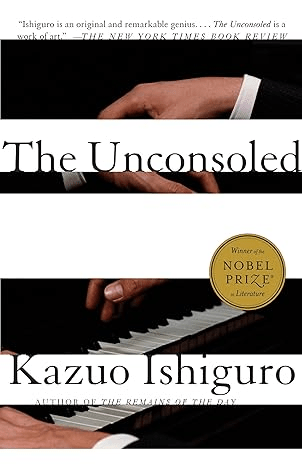
This is Ishiguro’s most divisive book, and his most psychologically exact.
Operating entirely on dream logic, The Unconsoled captures anxiety as an environment rather than a feeling. Time collapses. Characters seem more symbolic than flesh and blood. Obligation becomes absurd and inescapable.
For some readers, this is unbearable. For others it can be revelatory.
It may not be his most emotionally piercing novel, but it is his most immersive depiction of inadequacy and social pressure. Its length and relentlessness keep it just outside the top tier but it’s a unique book in the whole literature canon.
3. An Artist of the Floating World

This is where Ishiguro’s voice fully sharpens.
Set in postwar Japan, the novel examines artistic responsibility and moral compromise without spectacle. The narrator reflects calmly, politely revising his past as social cues shift around him.
What makes this novel extraordinary is its gradual exposure. No confession is required. Truth emerges through omission, hesitation, and social discomfort.
This is Ishiguro’s restraint at its most controlled and effective.
2. Never Let Me Go

Few novels introduce dread as quietly as this one.
The speculative premise arrives slowly, almost casually, allowing horror to normalize itself before the reader fully understands the stakes.
What elevates Never Let Me Go is its refusal of melodrama. The characters accept their fate not because they are weak, but because they have been taught to understand the world that way.
It’s a novel about systems that persist through normalization, and about love that survives without hope.
1. The Remains of the Day

This is Kazuo Ishiguro’s greatest novel, and one of the great novels of moral self-deception.
Stevens’ devotion to professionalism becomes a shield against personal regret and emotional risk. Each small rationalization accumulates until the weight becomes unbearable.
The tragedy is complete not because of what happens, but because of what never does.
Ishiguro’s central achievement is a subtle but powerful portrait of a life lived impeccably and wasted quietly.
Why Ishiguro Matters (and Where to Start)
If you’re new to Ishiguro, start with The Remains of the Day or Never Let Me Go. If you’re interested in his psychological experimentation, try The Unconsoled. For historical and moral nuance, An Artist of the Floating World is essential.
Ishiguro doesn’t reward urgency. He rewards attention.
His novels wait for you to notice what his characters cannot.


