
U.S. Girls Albums Ranked: From Tape Hiss to Disco Fire
Meg Remy’s U.S. Girls began in the fog of tape loops, cheap percussion, voices buried under hiss, songs that sounded like they’d been recorded through a wall by someone who didn’t want the landlord to hear. Over time, the project grew bigger, brighter, weirder, meaner, and more glamorous. Glam rock kicked the door in. Synth-pop got lipstick on its teeth. Disco showed up. Gospel, country soul, funk, garage rock, full-band heat.
The early weirdness never really disappeared but it did learn some fancy choreography.
Ranking U.S. Girls albums is tricky because the experience varies so much across them.The lo-fi records are rough, sometimes hostile, but occasionally thrilling because they feel like damaged transmissions from a parallel pop universe. The later records have bigger hooks but they also find sneakier ways to poison the punch bowl with songs of coercion and everyday horror.
This ranking covers the nine main U.S. Girls studio albums, from Introducing… through Scratch It. I’m weighing songwriting, sound, consistency, emotional force, and how completely each record builds its own strange little world.
Now let’s walk into the funhouse.
9. Introducing… (2008)
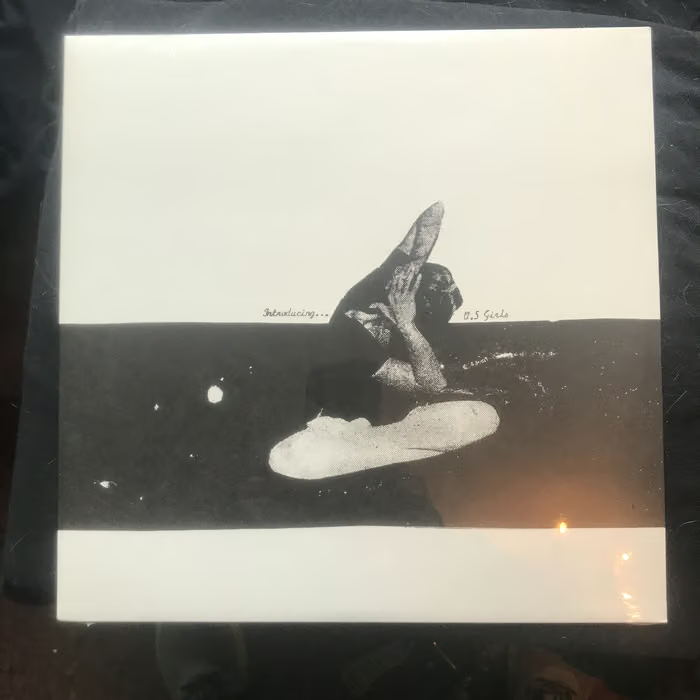
Introducing… sounds like pop music being remembered by a machine with a fever.
A voice drifts through tape hiss. Little scraps of melody appear, vanish, and come back looking bruised. The whole thing feels half-dug-up, half-beamed-in, like an old girl-group record decomposing in real time.
The rawness is not an aesthetic choice but a budgetary one, and sometimes that limitation works.
The best moments have a creepy pull. Repetition that starts to feel hypnotic. The buried vocals make the songs feel private in an almost uncomfortable way, like you’ve accidentally intercepted something you weren’t supposed to hear. You can already hear the future U.S. Girls playbook forming in the static: collage, pop nostalgia, vocal disguise, rhythm as hypnosis, beauty made suspicious.
It’s all there.
Sort of.
The problem is that hearing the blueprint is more interesting than living inside the building. A lot of these songs don’t develop so much as hover in place until the air goes stale.
Later records would keep the damage but give it sharper teeth and actual escape routes.
Introducing… plants the seed that clean sound is not to be trusted and pop memory is warped.
But it’s the U.S. Girls album I reach for least.
8. Go Grey (2010)

Go Grey is heavier than the debut. Grayer too, as advertised. Nice of it to warn us.
The loops don’t drift so much as grind. Remy’s voice is still trapped under layers of noise, but now the struggle feels like part of the rhythm. These songs move in tight, ugly circles. They repeat until repetition itself starts to feel like the room you can’t leave.
At its best, Go Grey makes a few blunt ingredients feel almost physically oppressive. A sound scrapes against itself. Nothing opens. Nobody comes to rescue you with a bridge.
That refusal can be powerful. It can also be a bit like being locked in a closet with a drum machine that has unresolved childhood issues.
Compared with Introducing…, the choices feel more deliberate. The noise has weight, it’s not just murk. Remy sounds increasingly aware that confinement can be a style, not just a condition.
Still, the album spends a long time staring at the same wall.
I respect Go Grey. I admire its stubbornness. I like that it does not care whether I’m comfortable.
But do I often think, “You know what I need right now? Forty minutes of psychic basement music”?
I do not.
7. Bless This Mess (2023)

Bless This Mess is shiny in a way that makes me a tad suspicious.
Everything here snaps into place. The beats are clean and the keyboards gleam. The vocals have a bright digital finish, like they’ve been polished with a microfiber cloth.
That sound makes sense. This is an album about motherhood, automation, housing, work, technology, systems, and the very modern sensation of being processed by invisible machinery while trying to make breakfast.
The coldness is part of the argument and when it works, it really works. Bless This Mess catches that surreal overlap between body and machine, between pregnancy and digital life, between domestic intimacy and economic pressure. It understands the horror of living inside systems that want to quantify everything, including the messy animal stuff no spreadsheet can survive.
That’s all well and good but the problem is that the songs don’t always leave a mark.Too often the melodies feel like they’ve been assembled rather than summoned. Some tracks click while others glide past, bright but oddly bloodless.
I like the antiseptic shine and the paranoia humming beneath it. Also the way it makes the future sound like a nursery with fluorescent lighting.
I just wish more of it grabbed me by the collar.
6. U.S. Girls on KRAAK (2011)

KRAAK is where the early U.S. Girls fog grows a face.
The songs still sound assembled from damaged records or pop songs remembered after a head injury. But Remy’s voice starts pushing forward with more character. She croons, mutters, hovers, and occasionally sounds like she has wandered in from some forgotten lounge record and decided to set the curtains on fire.
Go Grey often feels sealed inside its loops, whereas KRAAK stages them. There are entrances now, a sense of performance. The room is still murky but someone has turned on a red bulb in the corner.
That’s the fun of KRAAK, the sense that U.S. Girls is becoming less of a sound experiment and more of a haunted cabaret act with a broken tape deck.
It’s still abrasive and uneven. Still not exactly the album to play when company comes over, unless your company enjoys being quietly menaced by lo-fi ghosts.
But the weirdness has a personality now.
KRAAK is the best of the earliest records because it gives the noise a character to follow.
5. Heavy Light (2020)

Heavy Light sounds crowded, but in a good way. Like everyone showed up to the séance and brought percussion.
Pianos roll through. Horns appear. Group vocals lift the songs out of the private murk of earlier U.S. Girls records and place them in a room full of bodies. These are not transmissions from a lonely bedroom anymore. Other people are breathing inside the music.
The album revisits some older U.S. Girls material in fuller, looser arrangements, but it doesn’t feel like a victory lap. It’s like a memory being dragged into public and asked to explain itself.
Then the record keeps interrupting itself with spoken childhood memories. Some are funny, some are sad. Others feel only loosely connected to the songs around them. Together, they create the feeling of many lives being remembered at once, not neatly or chronologically, more like a dinner table where everyone has had one glass too many and suddenly the past is standing in the room.
That fragmentation is part of the album’s appeal.
The music can feel warm, theatrical, and almost celebratory. Then it turns solemn without warning. The title fits. The heavy parts float, the light parts have weight.
Heavy Light opens the U.S. Girls universe and lets more people inside.
Risky move, letting people inside.
Naturally, the ghosts come too.
4. Gem (2012)

Gem kicks the curtains open and suddenly there are guitars. Actual swagger. Glam-rock stomp, new-wave tension, blunt riffs, dramatic vocals. U.S. Girls starts moving toward pop, but not the clean, obedient kind. More like pop with eyeliner running down its face at 3 a.m.
This is the breakthrough before the breakthrough.
Remy sounds energized by the scale. Her voice is no longer another ghost buried under the floorboards. It takes command. It sneers, cools off, flares up, steps back, then lunges again.
The production gives the melodies room to hit, but it doesn’t sand away the strangeness. The rough edges remain. They scrape against the bigger sound in exactly the right way.
The early records built tension through scarcity. Not much sound, not much light, not much air.
Gem realizes that volume can be unsettling too. So can a hook that walks in like it owns the place and then starts saying very strange things.
It’s less intricate than an album like Heavy Light, but it has more forward motion.
3. Scratch It (2025)

Scratch It breathes.
That sounds simple, but in the U.S. Girls catalog, it’s a big deal. This project has often thrived on enclosure, on loops, layers, voices in disguise, and rooms with no windows. Scratch It lets the air in.
You can hear musicians leaving space for one another to turn, stumble, lean back, push harder. The album was made with a live band, and that human interplay gives it a looseness that feels almost shocking.
Country soul, gospel, garage rock, soft rock, disco, and bar-band warmth move through the record without becoming a costume parade. The band sounds comfortable inside these styles. More importantly, Remy sounds comfortable letting the performances stay open.
That makes the album warmer, but not lighter. Don’t be fooled. This is still U.S. Girls. The room may have better ventilation, but grief is sitting by the amp.
Pleasure and mourning keep brushing against each other. Songs sway, shuffle, glow, and ache. The record feels less like a puzzle box than a place where people gathered because something bad happened and somebody still had to play.
“Bookends” is the centerpiece, and it is devastating. Not in a melodramatic way. In a slow, room-clearing way. Its length gives sorrow time to move around without being shoved into a tidy climax. The band doesn’t force the song upward. It stays with it, and it’s an incredible thing when you hear it change gears two-thirds of the way through.
Ranking a recent album this high always feels dangerous. Maybe time will knock it down. Maybe it will rise.
Right now, it feels substantial.
It gives us a new kind of U.S. Girls record that’s less obsessively layered, more willing to trust the room.
And somehow, by loosening up, it hits harder.
2. Half Free (2015)

Now we’re at the top two. These are a cut above the rest and the reason we’re all here
Half Free is where the early U.S. Girls methods become great songs, not just interesting textures or warped pop experiments.
The loops still scrape. The drum machines still push with mechanical insistence. Remy’s voice moves between characters: cool, composed, frightened, bitter, almost cracking, then suddenly very calm in a way that is worse.
Everything has purpose now.
The pop hooks are immediate, but the spaces inside them feel unsafe. The sound is murkier than In a Poem Unlimited, and that murk helps. Bass lines throb underneath dusty production. Synths flare like warning lights. Vocals often feel like they’re occupying a different room from the track, close enough to hear, not close enough to save.
Remy’s character writing reaches a new level here. She doesn’t leave people as victims or villains. The narrators are angry, compromised, frightened, funny, and capable of turning their own pain outward. No one gets cleaned up for easy sympathy.
The songs rarely resolve their tensions. They just let them keep humming under the hook like a bad appliance you’ve learned to sleep beside.
Half Free may be the purest version of the U.S. Girls project, the early collage weirdness fused with actual narrative pop songwriting. Nothing feels accidental here.
It is catchy, bruised, paranoid, funny in a way that hurts, and psychologically exact.
1. In a Poem Unlimited (2018)

In a Poem Unlimited understands something a lot of political albums forget, that a message still needs a body.
And this record has hips, teeth, sweat, lipstick, muscle, a nervous system, maybe a criminal record. The drums snap. The bass lines slide. Horns flash. Guitars twitch around the edges. Disco, funk, soul, synth-pop, and psychedelic rock move through the album like they all showed up to the same party and decided to commit a small felony together.
The stories are full of abuse, surveillance, pollution, revenge, gendered power, and people who know exactly how much they can get away with.
That contrast is the charge.
Remy and the band never treat pleasure as a distraction from the politics. The groove makes you complicit and by the time the threat comes into focus, your body has already signed the contract.
That is the whole dirty trick and it works over and over.
The arrangements are essential. They give the songs depth without clutter. Every part seems to push the narrative forward. Remy’s performances are just as sharp. She can sound controlled, furious, amused, seductive, exhausted, or eerily calm. Her narrators often seem to know more than they are willing to say, which is usually how danger talks.
Compared with Half Free, this album feels less enclosed. The pressure has moved out of private rooms and into public space. It’s not only the bedroom, the kitchen, the bad relationship, the trapped interior life. It’s the street. The club. The polluted sky. The state. The men with clean shirts and filthy hands.
Everything U.S. Girls does best is here at once. Collage, character, rhythm, anger, pleasure, menace, hooks, heat.
In a Poem Unlimited is the best U.S. Girls album because the sound and subject are inseparable, they make those ideas sweat under the lights.
The Hook Is Never Innocent
The U.S. Girls catalog does not evolve so much as shed skins in public.
The tape hiss of Introducing… becomes the hard gray throb of Go Grey. KRAAK gives the murk a face. Gem discovers guitars, scale, and a better pair of boots. Half Free turns collage into character-driven pop. In a Poem Unlimited throws those stories onto a dance floor where every light is flattering and every exit may be locked.
Then Remy keeps moving.
Heavy Light revisits the past with more bodies in the room. Bless This Mess slides into clean electronic unease. Scratch It loosens the grip and lets the band breathe.
The sound changes, the central trick remains.
U.S. Girls understands that familiar music lowers your guard. A groove can make something ugly feel attractive for four minutes. A chorus can turn anger into communal pleasure. A voice can slip into character without giving you a safe distance from what she says.
The best U.S. Girls records know hooks have power.
They use that power irresponsibly and beautifully.
Enjoyed this ranking? Explore our full Music Rankings and Author Rankings hubs for more album lists, book rankings, and deep-dive guides. Including:


